
Flappy Bird: one button, almost no spare attention
The next gap is visible. Your last mistake is fresh. There is only one input, and somehow that is plenty. Flappy Bird is a useful lesson in how much work a small control loop can carry.
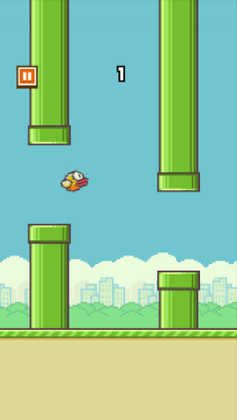
The gap is easy to spot. What this still cannot tell you is how fast the bird is rising or falling. That missing information is half the timing problem.

In this guide
This analysis concerns Dong Nguyen’s original 2013 Flappy Bird, using contemporary interviews and its documented core rules. The playable experiment is an original Dashpop timing model with different art and tuning.
- Made by
- Dong Nguyen / dotGears
- Looking at
- Original 2013 game
- Design question
- Timing, anticipation, and the cost of retrying
The design bet: make the next correction matter
Flappy Bird asks you to tap to gain height and avoid the pipes. The objective is a high score. That short description is enough to understand what you are meant to do; it does not tell your hand when to do it. Contemporary reporting and an interview with Nguyen establish this basic structure.
Our reading is that the game gets unusual mileage from the gap between understanding an instruction and being able to carry it out. You can recognize a safe opening while still arriving at it with the wrong motion. The work is in correcting your trajectory early enough, without correcting so much that you create the next problem.
This is the first useful distinction for a small-game maker: a small input vocabulary does not necessarily mean a small decision space. A button’s meaning can remain fixed while the moment in which you use it changes everything.
You are choosing both when to act and when to stop
Consider a fictional training scene with a rising ball approaching a gap. The ball is below the gap’s center, so “tap to go up” sounds reasonable. But it is already rising quickly. Another tap could carry it into the upper edge. Position gives only half the story; motion supplies the rest.
Now imagine the opposite: the ball is near the center but falling quickly. Doing nothing looks safe in a still image and fails a moment later. A screenshot can make both decisions look easier than they are. The player is reasoning about where the object will be, not just where it is.
This suggests a useful design question for any one-button game: what information makes waiting an active choice? If the answer is nothing, waiting may just be dead time. If velocity, an approaching obstacle, or a cooldown changes what will happen next, restraint becomes part of play.
You do not need to expose a velocity meter. Motion itself can communicate the state. You do need consistent behavior. If identical-looking situations demand different inputs because of an unexplained hidden state, the player loses a basis for learning.
Play it: lift, coast, correct
The little experiment below keeps the idea of discrete upward inputs and approaching gaps. Its circles, gates, numbers, and physics are ours. Try passing three gates, then widen the gap or lower the scroll speed. Change one setting at a time.
Before a miss, were you reacting to the ball’s height or anticipating its motion? Try a run in which you deliberately leave more time between lifts. The point is to notice the relationship, not to reproduce your score in Flappy Bird.
Five gates, one lift button
Tap Lift, or focus it and use Space/Enter. Each lift sets an upward velocity; gravity brings the ball down. Pass five gates. Pause or reset at any time.
Ready when you are.
This is an original illustrative model. Its tuning, contact shapes, and gate sequence are not measurements of Flappy Bird.
A readable mistake can still feel unfair
A clear collision gives the player a candidate explanation: I hit that edge. It does not prove the collision matched what they saw or that the next attempt will feel under their control. The shape used for contact, the art, the camera, and input response all participate in that judgment.
For your own prototype, make the contact shape visible temporarily. Ask someone to point at the place they expected to pass safely. Compare their expectation with the actual boundary. If the pictures disagree, rewriting the tutorial will not fix the problem.
Next inspect the input itself. A tap should cause a visible response promptly enough that a person can connect action and consequence. An animation that looks delightful in isolation can become a problem if it masks the instant an input took effect.
Separate two diagnoses. “I chose the wrong moment” is a timing problem the player may enjoy solving. “The game ignored the moment I chose” is a trust problem. Making the gap wider can hide either problem for a while, but it will not tell you which one you had.
One more obstacle is an unusually legible goal
A count of passed obstacles translates progress into a question that is easy to hold in mind: can I get one farther? There is little translation between the event and the measure. Compare that with a score assembled from hidden bonuses, multipliers, and end-of-run conversions. A larger score can be less informative if the player cannot explain it.
That does not make elaborate scoring bad. Balatro builds a game around understanding such transformations. It means scoring should fit the intended attention. In a timing game, the next obstacle can carry the goal while the player spends their attention on motion.
Try replacing a prototype’s point total with a visible sequence of five challenges. Ask a player what improvement would look like before they begin. Then restore the score and ask the same question. You are testing which representation makes progress understandable, not which produces the largest number of attempts.
Keep the end of a run useful. The final state can show the obstacle, the contact, and the achieved distance. If it disappears instantly under menus and offers, the player loses the best opportunity to connect a result to a decision.
A small mechanic is not an explanation for a viral hit
Nguyen’s 2014 Forbes interview describes a game intended for brief play and his concern about what its popularity had become. That is a reason to be careful with the word “addictive,” not a recipe for designing around it.
The visible rules let us discuss a timing loop. They do not isolate the causes of distribution, social attention, advertising income, or a particular person’s repeated play. Those are different questions with different evidence requirements. A successful game is not a controlled experiment in which every other variable stayed fixed.
For Dashpop readers, the useful target is a legible, satisfying interaction that respects someone’s time. If you are making a tiny arcade game, let a session end cleanly. A player returning because they enjoyed a skill is a different design aspiration from a player feeling unable to leave.
The practical trap is survivor bias: inspecting one famous small game and concluding that small games reliably become famous. Study the control relationship because you can test it. Treat the commercial outcome as context, not a promised reward for implementing a tap.
Change the control and you change the skill
Imagine replacing discrete lifts with a button you hold to rise and release to fall. That version might be excellent, but it asks for a different rhythm. Holding creates a continuous commitment; tapping creates repeated corrections. A controller can use one physical button in both versions and still teach a different skill.
Or remove vertical motion entirely and let the button switch between two lanes. The task becomes selecting a lane at the right moment. It may be easier to explain the state, but you lose the changing relationship between height and velocity.
These counterfactuals help identify what to preserve in your own idea. If the interesting part is anticipating inertia, keep inertia through the first prototype. If the interesting part is choosing an opening, a lane-switching version may be a cheaper way to test that question.
Read an attempt as a chain of commitments
A screenshot tells you the bird's position. It cannot tell you whether the bird is rising quickly, beginning to fall, or already falling too fast to recover. Two attempts can pass through the same point and have very different futures. That makes velocity part of what the player must learn to read.
In our flight experiment, try reaching the first opening while still rising. Then try arriving near the top after the rise has slowed. Both entries can be safe at first, but the next tap has a different meaning. In the first, another lift can spend headroom you no longer have. In the second, waiting may be the better action. “Tap at the gap” is a weaker plan than “arrive with room to correct.”
This is a chain of commitments. A tap changes the path before the next opening; the entry leaves a position and velocity for the exit; the exit constrains the next approach. The obstacle is doing more work than checking a single instant. It is asking the player to leave themselves a future.
For your own one-button game, watch the moment just before a failure. Could the player still recover there, or was the decisive input earlier? If the decisive moment is invisible, players may blame the final tap for a mistake already committed. A clearer trajectory, more readable speed, or a different obstacle interval can help.
Tune the relationship, not three sliders at once
In the embedded toy, compare two gap settings with the same speed. Make a few attempts in each and write down the type of collision rather than treating a tiny sample as a balance verdict. Ceiling, floor, and obstacle contact suggest different problems. Then return to the original gap before changing speed.
Difficulty is not a single quantity. A narrow opening asks for precision; high speed limits preparation; a powerful lift reduces the size of a safe correction. Any can increase failure, but they teach different habits. The useful setting is the one that supports the kind of mastery you want.
| Experiment | Keep fixed | Look for |
|---|---|---|
| Widen the opening. | Speed and lift. | Do players gain correction room, or simply stop needing a plan? |
| Slow the obstacles. | Opening and lift. | Does extra time make the next tap easier to judge? |
| Change lift strength in your own prototype. | Opening and obstacle speed. | Does one tap become too large a commitment near the ceiling? |
What does the next attempt let you change?
A quick restart preserves the memory of the last mistake. That only helps if the player has an adjustment to try. “Tap a little later before the second opening” is a plan. “Maybe it will work this time” is less evidence of learning. Neither sentence alone proves how the player feels, so listen and watch together.
Ask someone to describe their next adjustment after a miss, then let them try it without advice. If the new action changes the result in the predicted direction, the system is giving them useful feedback. If the same input seems to behave differently, inspect starting conditions and timing before assuming the player is inconsistent.
Do not infer the cause of a game's popularity from this small learning loop. Distribution, visibility, culture, and personal circumstances sit outside the toy. The lesson you can actually test is narrower and valuable: repeated attempts should make the action more understandable. Your first prototype can test that without chasing a historical hit.
Build a timing question, not a bird-shaped copy
A useful result might be: “With the slower approach, the player could explain why they missed, but with the faster one they could only guess.” That is a design finding you can use. “This will be the next Flappy Bird” is not.
- Choose an original premise: a paper lantern riding gusts, a submarine using short ballast pulses, or something of your own.
- Build one input, one movement rule, one repeating obstacle, visible failure, and a restart. Use plain shapes.
- Expose only two tuning controls at first: the size of the opening and the time before it reaches the player.
- Test three attempts per version with the same person. Record what they thought the next input would do and what actually happened.
- Make one revision that addresses an observed mismatch. Keep the premise and scoring unchanged while you compare.
Sources & further reading
Official material and creator accounts behind this analysis. The interpretations, examples, and interactive models are Dashpop’s own.
Put your idea to work with the Dashpop Game Engine. Describe a game, play it quickly, and shape it yourself. Start with one change you can test.