
Baba Is You: the rules are objects in the room
Most puzzle games let you move within the rules. Baba Is You lets you move the rules. That one change makes the room both a place to navigate and a description you can rewrite.
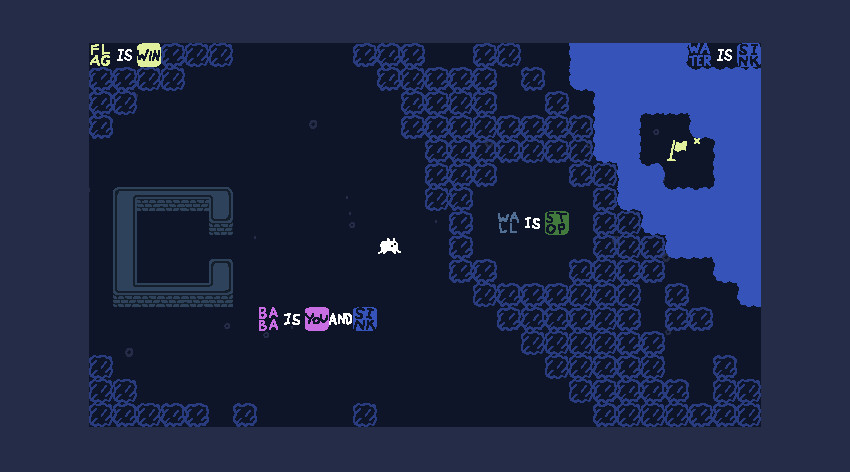
The rules are part of the picture. The water, walls, flag, and Baba each have a meaning the player can inspect in the words on the board.
In this guide
Source-based analysis of the rule-changing premise and creator commentary. We avoid specific commercial level solutions. The tiny workshop uses original objects and a restricted rule set; it is not a Baba level or a full rule engine.
- Made by
- Arvi Teikari / Hempuli
- Looking at
- Core rule-changing puzzle design
- Design question
- Rules as objects, constraints, and reversible experiments
The design bet: turn the explanation into something you can move
Hempuli’s official description presents a puzzle game whose rules are blocks you can interact with. Rearranging them changes how the level works. The creator interview explains the relationship between moving words and rebuilding the active rules.
Our reading is that the idea unites two usually separate layers. The player sees a world and the statements that govern it in the same place. A physical action can therefore change what other physical actions mean. The room becomes both the problem and part of the language for solving it.
This is a powerful premise, but not a free supply of good puzzles. Once a player can change rules, the designer has to manage which changes are available, what they communicate, and what happens when they interact.
A rule’s location can matter as much as its meaning
Consider an original paper puzzle with a statement that makes a pebble solid. You can move the word that supplies the property, but only if there is empty space behind it. The logical possibility exists; the spatial arrangement decides whether you can reach it.
That gives the designer two kinds of constraint. A vocabulary constraint determines which transformations can be expressed. A spatial constraint determines which expressions can be assembled now. Combining them can make a small room surprisingly rich without adding a long list of verbs.
The risk is clutter. If a room includes many active statements, the player has to remember them while planning movement. The cost is not just reading time. A change may affect several objects, so the player must update their mental model and then continue solving.
For your own rule puzzle, write down the one conceptual discovery the room should teach. Remove a statement and ask whether that discovery still works. If it does, the statement may belong in another room. A clever rule that is irrelevant to the intended question still consumes attention.
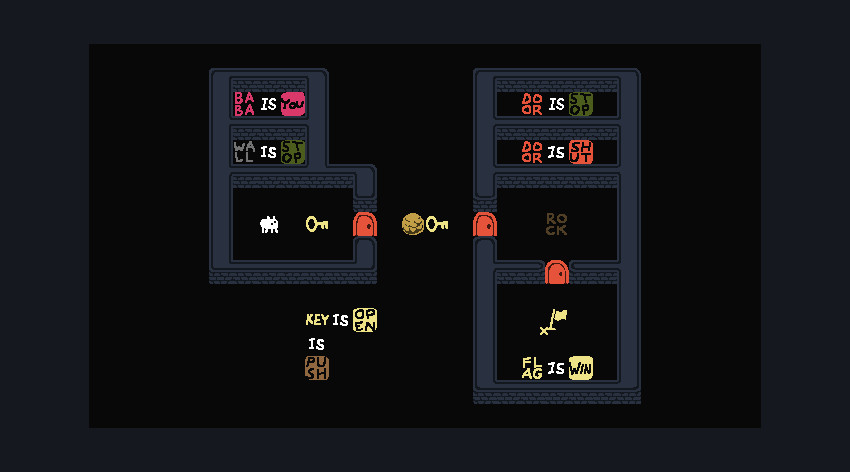
A rule can be perfectly readable and still hard to change. Doors, narrow passages, and the space around word blocks make this a spatial problem as well as a logical one. No solution shown.
Play it: change what the obstacle means
In this original workshop, the same pebble can be solid, pushable, or the goal. Choose a rule, then move the courier along the row. The rule is selected with buttons rather than moved as word blocks, so this isolates consequences before adding the spatial grammar.
Try all three versions. Becoming able to reach a destination and changing what counts as the destination are different solutions. Describe the change in the problem, not just the button that worked.
Same pebble. Different problem.
Reach the door at the right, or change the pebble into a goal and touch it. A solid pebble blocks movement. A pushable pebble moves one space if there is room. You can undo moves and rule changes.
Courier at 1. Pebble at 4. Rule: solid.
What did a menu remove from the problem? In a spatial rule puzzle, you would also need to reach and arrange the rule itself.
A surprise should become understandable afterward
A strong puzzle revelation changes what the player notices. Something that seemed fixed becomes movable; something that seemed decorative becomes relevant. After the discovery, the player should be able to trace why it works through the game’s language.
Contrast that with an arbitrary exception. If one object ignores a rule because the designer needed the intended solution to work, the player cannot carry the lesson into the next room. They have learned a special case rather than a useful relationship.
For an original puzzle, ask a tester to explain the solution after finishing. Listen for a causal account: changing this property allowed this move, which opened that space. “I tried everything and one thing happened” may indicate a solution that is possible without being legible.
You can respond by improving the setup, reducing competing rules, or adding a preceding room that teaches a component relationship. You do not necessarily need a hint that gives away the answer. Sometimes the missing ingredient is a clearer question.
Undo makes an action cheap enough to become a question
The documented game includes undo and restart, which matter in a system where changing a rule can remove your ability to continue. Our interpretation is that reversibility supports a particular form of reasoning: try a consequence, inspect it, then return without treating the experiment as a ruined session.
For a rule-based prototype, undo should restore the relevant world and rule state together. If the objects move back but an altered property remains, the player is no longer comparing states they understand. This is both an implementation concern and a learning concern.
Do not make the player repeatedly rebuild the solved prefix of a puzzle just to investigate one uncertain move. That overhead encourages cautious guessing or external lookup. If your intended pleasure is experimentation with rules, make experiments affordable.
Reversibility does not mean a puzzle has no consequences. Within an attempt, an action can still block a route or invalidate a rule. Undo changes the cost of investigating that consequence. The distinction is worth making explicitly when you design a puzzle about irreversible commitments.
The unintended solution is evidence before it is a bug
Teikari describes tester discoveries that influenced alternate versions of levels, along with ideas cut because they required too many supporting rules. That creator account makes a useful point: a flexible system produces solutions the author did not initially plan.
When that happens in your puzzle, resist deciding immediately whether the player cheated. First describe what they did and which rules allowed it. Then ask whether the solution preserves the concept you wanted the room to explore.
If the solution is elegant and teaches the same relationship, keeping it may make the game richer. If it bypasses the room’s only interesting decision through a routine move, you might change the arrangement. If preventing it requires five new exceptions, a different room may be the cleaner answer.
A useful design record contains the intended discovery, the alternate solution, the proposed constraint, and what that constraint costs in readability. This makes it harder to protect your first idea simply because it was first.
More vocabulary creates more promises to keep
Every new word or property suggests combinations a curious player may try. That is part of the appeal. It also creates a responsibility to resolve interactions consistently. The interface is implicitly saying these pieces belong to a shared language.
Start a compatibility table for your own small system. What happens when an object is both movable and a goal? What if two objects overlap? What if the controlled object changes identity? You may exclude some combinations, but make the exclusion understandable rather than silently changing the rules at the moment of contact.
The creator interview discusses the additional work caused by stacked words, which challenged an earlier one-word-per-space assumption. We should not turn that account into a prescription for your engine. The general lesson is to test the consequences of the expressive freedom your interface offers.
A small vocabulary that consistently rewards experiments can carry more trust than a large vocabulary full of unclear exceptions. Add a word when it opens useful questions you are prepared to answer.
If the rules move to a menu, what disappears?
Our workshop uses a menu to choose the pebble’s property. That makes the change easy to inspect, but removes the need to arrange words in space. It is a teaching model of rule consequences, not a substitute for the original design.
This counterfactual helps locate the important relationship. When rules are physical objects, moving toward a statement, making room for it, and avoiding accidentally breaking it can all become part of the puzzle. A menu removes those spatial costs and may turn a discovery into a straightforward selection.
A menu-based rule game could still be interesting if another constraint supplies the decision, such as a limited number of changes or a cost for each property. The point is to notice which work the physical words were doing before you replace them.
Play it: the rule takes up space
The first toy lets you choose a rule from a menu. This one makes the rule an object in an original little room. A horizontal sentence, GATE IS SOLID, keeps a vertical barrier closed. Move the courier around the words and push SOLID out of its row to break the sentence. Then reach the delivery point on the right.
Words occupy cells and can be pushed one square at a time. The whole sentence must align to make the barrier solid. You can also move GATE or IS, so there is more than one solution. Use Undo freely. This room teaches a spatial relationship; it does not reproduce a Baba Is You level or its full language.
Before moving, predict both consequences: where the word will go, and whether the sentence will still exist. A move can be spatially possible but strategically unhelpful. Try restoring the sentence after breaking it, then inspect what you have learned about the barrier.
A sentence in the way
Push a word out of GATE IS SOLID to open the striped barrier. Reach the mailbox on the right. Words cannot be pulled or pushed through each other. Use the buttons or focus the board and use arrow keys.
Word tiles: G = GATE · I = IS · S = SOLID.
Courier: column 2, row 5. Barrier closed: GATE IS SOLID is intact.
Read the board as coordinates
Columns run 1–9 left to right; rows run 1–6 top to bottom. The barrier occupies column 6. The mailbox is at (8, 3). GATE: (2, 3). IS: (3, 3). SOLID: (4, 3).
Try breaking the sentence by moving a different word. Then undo and put it back. What stays true about every solution?
A word is both meaning and matter
The spatial rule creates two problems at once. You need to understand the sentence, and you need to reach a position from which you can change it. The rule may be obvious while the required push is not. That relationship lets a designer create a puzzle without making the vocabulary larger.
In the toy, the room is intentionally forgiving. Move the sentence close to a wall on paper and an extra question appears: can a word be pushed out and restored? Put another word behind it and a move may depend on clearing that space first. These changes alter the plan while preserving the meaning of GATE IS SOLID.
That is an economical way to build depth, but it carries a teaching cost. If a player has not learned that words can move, an awkwardly boxed-in word adds spatial difficulty before they understand the premise. Introduce the relationship where the result is visible, then make access to it interesting.
Ask what the player discovered
After the barrier opens, ask what caused it. “I pushed the word” describes an action. “The sentence stopped being true because SOLID left the row” describes a reusable model. Both can lead to a win in this room, but only the second predicts what happens if another word moves.
Test that prediction with a different arrangement using the same vocabulary. If the player succeeds again, ask them to explain it before adding a new property. A game can accumulate solved rooms without accumulating understanding if each solution is learned as an isolated trick.
Undo helps the player test a hypothesis without rebuilding the entire setup. It also helps the designer observe the thought process: change a word, inspect the effect, restore it, try another relationship. The puzzle still needs a clear question. An undo button cannot rescue a room whose important rule is hidden without a trail.
Treat an unexpected solution as evidence
Because the toy accepts any broken sentence, pushing IS works as well as pushing SOLID. That is intentional. If the learning goal is “sentence structure changes the world,” both routes demonstrate the idea. Forcing a single word to move would add a restriction unrelated to that goal.
For a harder puzzle, an unexpected path may bypass the intended discovery entirely. Before blocking it, decide what the room is meant to teach. Keep alternate solutions that express the same understanding. Revise the room when a shortcut removes the question rather than merely answering it differently.
Record the exact starting layout and move sequence when someone surprises you. “Players broke the puzzle” is not a useful design note. A concrete sequence lets you distinguish a consistent consequence of the rules from an implementation error. The former might be the most interesting thing you found that day.
Build one room with one surprising reinterpretation
Your first success is not a puzzle that stumps everyone. It is a puzzle whose solution changes how someone understands the room, and whose rules still make sense after that change.
- Choose an original set of objects and three understandable properties. Start with a paper grid.
- Write one intended discovery, such as changing what counts as the destination rather than moving closer to it.
- Build the smallest arrangement that makes the old approach fail and the new relationship worth considering.
- Add undo before expanding the vocabulary. Check that it restores positions and properties together.
- Give the room to someone who does not know the intended answer. Keep their alternate solutions and explanations in your notes.
Sources & further reading
Official material and creator accounts behind this analysis. The interpretations, examples, and interactive models are Dashpop’s own.
Put your idea to work with the Dashpop Game Engine. Describe a game, play it quickly, and shape it yourself. Start with one change you can test.